Offices Get Louder As You Get More Tired
When chronic cognitive fatigue drains the prefrontal cortex, the brain loses its ability to filter background sound. The problem is your workload, not your temper.
Work Survival Club · 14 November 2026 · 3 min · Original reporting
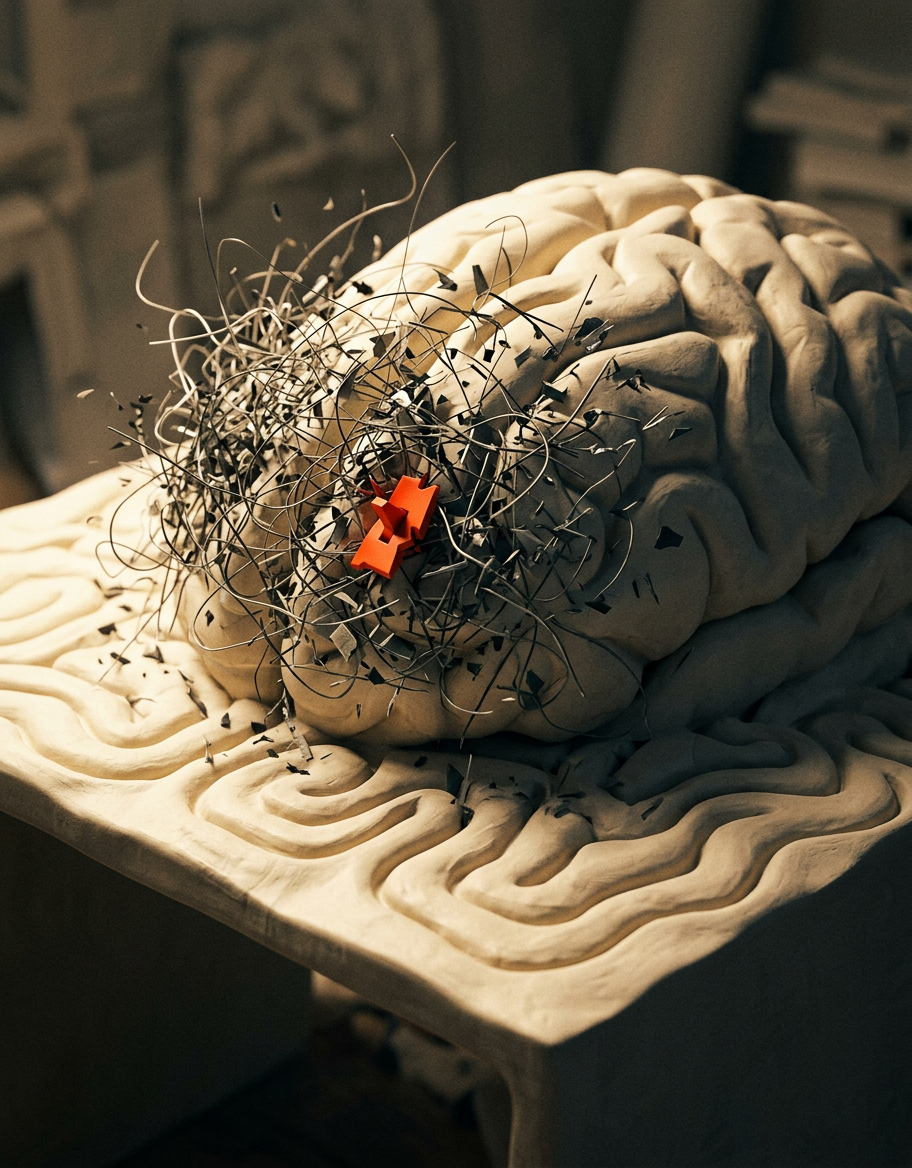
On Monday morning, the low-level hum of the office remains where it belongs: in the background. The drone of the ventilation system, the distant murmur of colleagues discussing a spreadsheet, and the intermittent squeak of an opening fire door all register as a single, harmless wash of texture. You get on with your work, barely noticing any of it.
By late Thursday afternoon, the physical environment has not altered, but your experience of it has turned hostile. A colleague four desks away is tapping a pen against a ceramic mug, and each tap lands like a small slap to the temples. You feel an immediate, disproportionate surge of annoyance. The common instinct is to blame yourself: you are being irritable, unreasonable, or losing your professional composure. Yet the ear has not become more sensitive, and the room has not grown louder. What has failed is your brain's top-down sensory filter.
The gate that stays open
Human hearing does not have eyelids. The auditory nerve constantly transmits a torrent of pressure waves from the environment to the brainstem. In an alert, well-rested nervous system, the prefrontal cortex and the thalamus run a continuous suppression protocol known as sensory gating. This neural circuit evaluates incoming auditory stimuli and suppresses redundant or irrelevant signals before they reach conscious awareness, preserving limited cognitive capacity for the task at hand.
Sensory gating is an active, metabolically expensive neurological process. Research led by neurobiologist Amy Arnsten at Yale University has demonstrated that sustained occupational stress and sleep restriction flood the prefrontal cortex with excessive levels of catecholamines, effectively taking high-level executive circuits offline (Arnsten, 2009). When cognitive resources are depleted by continuous triage and unyielding deadlines, this inhibitory control degrades. The thalamic gate swings open, and irrelevant acoustic signals flood working memory unrestricted.
Why effort makes the room louder
When workers notice their growing distraction, their default reaction is usually to apply more willpower. Studies on mental fatigue, including work published in Neuropsychology by Dirk van der Linden and colleagues, show that this strategy consistently backfires (van der Linden et al., 2005). Attempting to forcefully ignore intrusive stimuli requires the very executive control that prolonged fatigue has already crippled. The harder you try to shut out the nearby phone call, the more cognitive strain you generate, accelerating the breakdown of selective attention.
Irritability at ambient noise is not a temper problem; it is the physical sound of an exhausted nervous system losing its brakes.
Neuroimaging studies of individuals suffering from work-related chronic exhaustion confirm that sustained workload does not simply induce subjective tiredness; it alters functional connectivity between the prefrontal cortex and emotion-processing structures like the amygdala (Golkar et al., 2014). Without prefrontal dampening, mundane sensory inputs are interpreted as immediate irritants or micro-threats. This manifests across several recognisable stages:
- Acoustic intrusion: Background conversations cease to sound like ambient murmur and break through as distinct sentences, forcing your linguistic centres to process them against your will.
- Startle escalation: Routine noises—a chair scraping back, an incoming chat notification, a dropping stapler—trigger an instantaneous autonomic jolt rather than casual awareness.
- Social exhaustion: Group discussions or open-plan environments become physically punishing because distinguishing individual voices requires manual, deliberate concentration instead of automatic parsing.
Managing the depleted filter
The standard modern response is to install an external filter: high-end noise-cancelling headphones. While active noise cancellation provides valuable mechanical relief, treating acoustic hypersensitivity solely with consumer hardware misdiagnoses the problem. Relying on silicone tips to survive the working day treats a clear biological symptom of prefrontal depletion as an environmental inconvenience.
UK regulatory guidance on occupational health from the Health and Safety Executive recognises that excessive workload demands undermine cognitive functioning and emotional control (HSE, 2023). When the clicking of a colleague's pen begins to provoke genuine rage, take it as an objective indicator of physiological exhaustion. Step away from parallel inputs, decline non-essential coordination meetings, and recognise that your auditory filter cannot be repaired by trying harder. It requires the removal of cognitive load.
Sources
- Work-related stress: Risk assessment and management standards (opens in a new tab) — Health and Safety Executive guidance on identifying occupational strain and reducing demand-driven cognitive injury.
General information about work and health, not medical advice. See our medical disclaimer.