Sitting Bent Forward Forces Your Neck to Breathe
Slumping over a keyboard compresses the diaphragm, leaving the small muscles of the neck to haul every breath into your lungs.
Work Survival Club · 27 October 2026 · 3 min · Original reporting
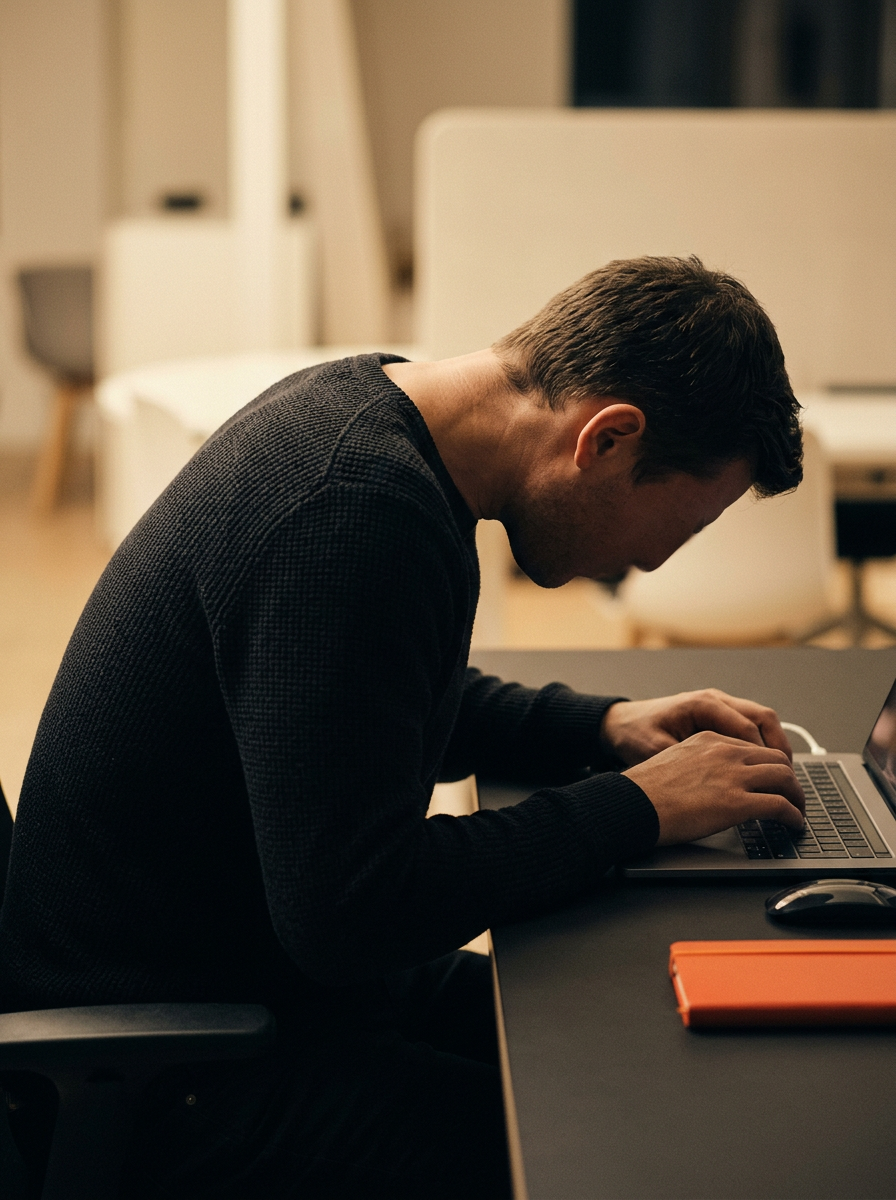
By three in the afternoon, the tension arrives at the base of the skull like an unwanted recurring calendar invite. Most people reach back, squeeze the tight cord of muscle between the neck and the shoulder blade, and blame either their monitor height or the way they slept. If the discomfort persists, they might adjust the lumbar cushion, tilt the display back three degrees, or purchase a contoured foam pillow. Yet the ache rarely shifts for long, because the joint being blamed is seldom the joint driving the problem.
Watch an office floor from the side and the postural pattern is almost uniform: pelvis tucked under, spine curved into a gentle C-shape, head jutting forward to meet the glass. In this position, the chest cavity collapses downward towards the lap. While workers notice the strain in their lower back or wrists, they rarely notice what this inward fold does to the mechanics of respiration. The human trunk cannot fold in half without fundamentally changing how air gets into the lungs.
The Mechanical Trap of the Collapsed Torso
The primary muscle of respiration is the diaphragm, a dome-shaped sheet separating the chest from the abdomen. When you breathe normally, the diaphragm contracts downwards, displacing the abdominal organs slightly to create negative pressure in the thorax, drawing air into the base of the lungs. For this piston-like stroke to work efficiently, the abdominal wall needs room to yield, and the lower ribs need space to swing outward.
Slumped sitting destroys that clearance. Flexing the thoracic spine compresses the abdominal viscera upward against the underside of the diaphragm, physically checking its descent. Research published in the Archives of Physical Medicine and Rehabilitation demonstrated that slumped postures reduce forced vital capacity and expiratory flow rates compared to neutral sitting. The lung simply cannot fill from the bottom when the floor of the ribcage is wedged tight against the thighs.
The Emergency Crew in Your Neck
Because your brain requires roughly twelve to twenty breaths every minute regardless of your posture, the respiratory centre must recruit secondary mechanics. If the diaphragm cannot push down, the upper ribcage must be pulled up. To achieve this, the central nervous system activates the accessory muscles of respiration: the sternocleidomastoid, the scalenes running alongside the cervical vertebrae, and the upper fibres of the trapezius.
An accessory muscle is engineered for a sprint, not a forty-hour week spent hauling the upper ribs upward sixteen times every minute.
Accessory muscles are physiological backups, meant to assist during intense aerobic exertion or respiratory distress. In a slumped desk worker, however, they become the primary engine of ventilation. Studies in the Journal of Physical Therapy Science have verified that adopting a forward-head posture directly spikes baseline electrical activity in the scalenes and sternocleidomastoids. Over an eight-hour shift, these delicate neck stabilizers contract thousands of times merely to lift the ribcage, developing ischemic trigger points, chronic tightness, and referral pain that radiates into the temple.
Three Points of Structural Strain
- Abdominal crowding: Sitting tilted forward jams intra-abdominal organs against the inferior border of the diaphragm, arresting its downward excursion.
- Costovertebral lock: Protracted shoulders and a rounded upper back fix the ribs at their spinal articulations, preventing the normal lateral expansion that fills lung bases.
- Scalene overuse: The small muscles bridging the cervical spine to the upper two ribs endure persistent tension, pulling the head further forward and irritating nearby nerves.
Reopening the Respiratory Engine
Remedying this pattern does not require rigid, military posture, which merely replaces one form of muscular clenching with another. The goal is to clear room for the diaphragm. British workplace guidance from the Health and Safety Executive stresses arranging chairs and desks to avoid forward reach. Opening the angle between your torso and your thighs to roughly 100 or 110 degrees immediately relieves intra-abdominal pressure. Bringing the keyboard close enough that your elbows hang vertically under your shoulders releases the trapezius from carrying your arms, allowing the ribcage to drop back into its natural axis.
During the workday, reset the system by leaning back fully into your chair backrest for sixty seconds every hour, letting your belly soften and expanding the lower ribs outward rather than hiking the collarbones toward the ears. When the diaphragm is granted room to descend, the neck muscles can finally step down from their emergency duties.
Sources
- Effects of forward head posture on forced vital capacity and respiratory muscle activity (opens in a new tab) — Clinical trial by Kim et al. demonstrating how forward head posture increases accessory respiratory muscle activation and limits lung capacity.
- The effect of the forward head posture on muscle activity in neck and the respiratory capacity (opens in a new tab) — Investigation by Kang et al. measuring elevated sternocleidomastoid recruitment during sustained forward head alignment.
- Working with display screen equipment (DSE) (opens in a new tab) — Official guidance from the UK Health and Safety Executive on workstation positioning to prevent musculoskeletal fatigue.
General information about work and health, not medical advice. See our medical disclaimer.