The 9:47 PM Email
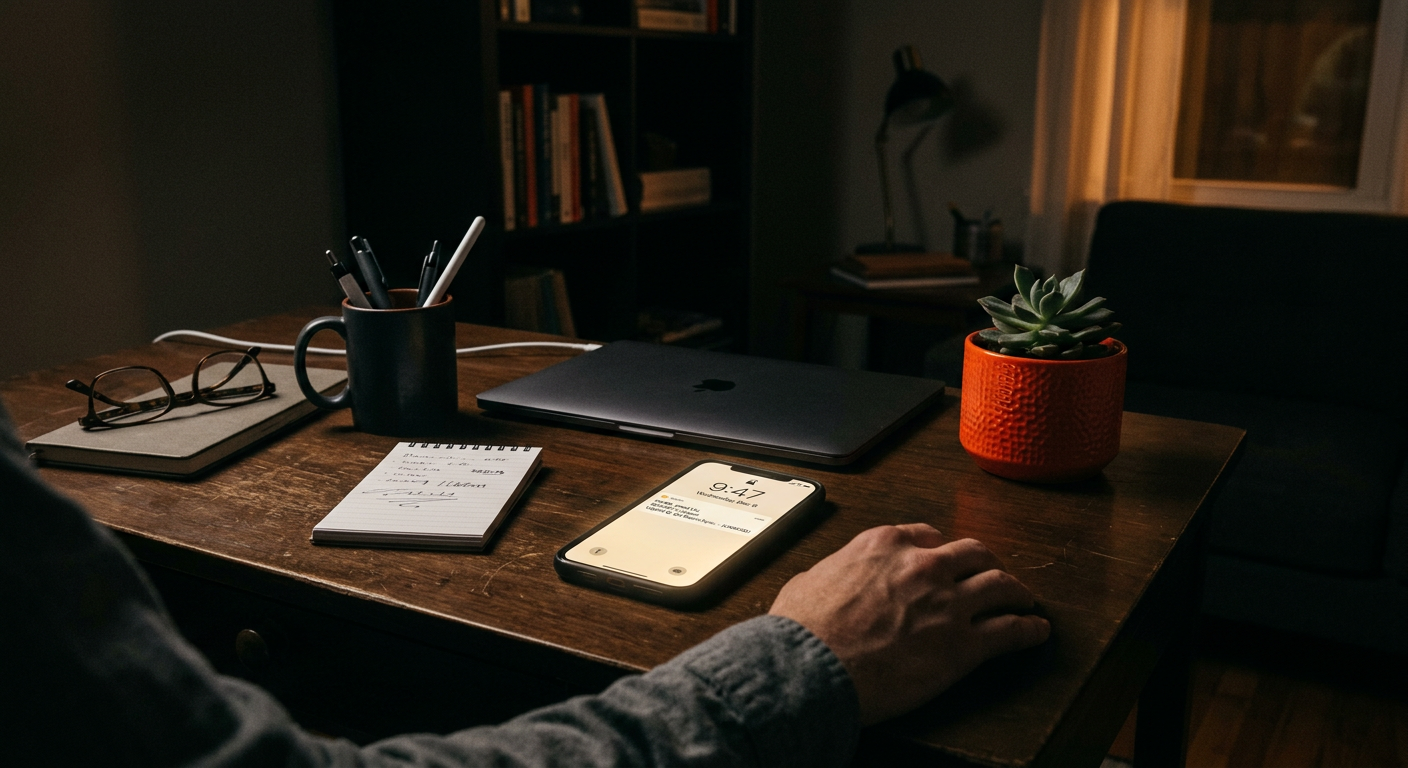
It is 9:47 on a Wednesday and your phone lights up with a work email. You do not need to reply. You do open it. Here is what the research says about what that thirty seconds actually costs, and what "psychological detachment" means when your job lives in your pocket.
Work Survival Club · 26 July 2026 · 5 min · Original reporting
The scene
You are on the couch. The dishwasher is running. The show is fine. Your phone lights up on the coffee table with the specific angle-of-light that means work email, and even before you pick it up, your shoulders have already migrated a quarter inch toward your ears. You open it. It is not urgent. You do not reply. You put the phone back down.
The show is still fine. You are, subtly, not.
That thirty-second interaction has a name in the occupational-health literature. It is a failure of psychological detachment, the ability to mentally disengage from work during non-work time, and a decade of research has been quietly mapping what happens when it goes wrong.
Why detachment is not a luxury
Sabine Sonnentag and Charlotte Fritz's stressor-detachment model frames psychological detachment as one of four recovery experiences, alongside relaxation, mastery, and control, that let the human system return to baseline after a workday. Their work, published across major organizational psychology journals, finds that people who mentally detach from work in the evening show lower fatigue, better sleep, better next-day mood, and lower long-term burnout risk.
Detachment is not thinking about work less because you are lazy. It is thinking about work less because your prefrontal cortex is running maintenance and you are letting it.
The problem is that email, and Slack, and Teams, and the sixteen other apps your job has installed on your phone, is specifically engineered to prevent the exact process detachment requires.
What the 9:47 email actually does
A 2021 observational study in the Journal of Occupational Health tracked 58 IT employees over a month using actigraphy (sleep tracking), saliva cortisol, and self-report. The finding was blunt: the frequency of work email after hours was significantly associated with worse psychological detachment, more rumination, higher carry-over fatigue, and worse sleep quality, even after controlling for total off-job time.
Read that again. It was not just working late. Even people with long evenings off, if they kept checking email, showed worse recovery. The duration of the break did not rescue the quality of it.
Separate research, including Arlinghaus and Nachreiner's work in Chronobiology International, has linked supplemental after-hours work to increased health risks over time. And a growing body of research on the telepressure construct, the urge to respond quickly to work messages regardless of actual need, links it to burnout, sleep problems, and physical symptoms independent of workload itself.
The email is not the problem. The email is the delivery mechanism. The problem is that your nervous system cannot fully leave work while the option to return is one glance away.
Why "just don't check it" is not enough
If it were that simple, half the population would not be doing it. There are three things making the behavior sticky.
One: variable-ratio reinforcement. Most emails you check are nothing. Occasionally one is genuinely important. That intermittent payoff is the same reinforcement schedule slot machines run on, and it is the most durable form of habit-formation known to behavioral science.
Two: anticipatory anxiety. Not knowing what is in the inbox often feels worse than knowing, even when knowing costs you a night. Checking is a way of managing anxiety in the short term at the cost of amplifying it in the long term.
Three: the visible-availability culture. In many workplaces, being reachable at 9:47 is not just tolerated, it is quietly rewarded. Promotion doesn't require it, exactly. But the person who was reachable is the person the boss remembers when a plum project opens.
Detachment, in that environment, is not a personal wellness choice. It is a political one, and pretending otherwise is why most advice on this topic fails.
What has actually started to work
Since 2017, several governments have moved on this, France, Portugal, Belgium, Ireland, Ontario, and Australia among them, with right-to-disconnect laws that vary in teeth but share a premise: after-hours work contact is a labor-conditions issue, not a personal one.
The research on early results is mixed. Compliance varies. Cultures adapt slowly. But even the presence of the law tends to shift the default a little, from "of course you would answer" to "you don't have to, and if you don't, that is protected."
At the individual level, the interventions with the most evidence are less about willpower and more about structural friction. Every step you add between the impulse to check and the ability to check is a step where detachment can happen instead.
A field guide for reclaiming your evenings
Not aspirational. Actual friction points, drawn from the research on habit formation and psychological detachment.
- 1Move work apps off the home screen. Bury Slack and email inside a folder on page three of your phone. The extra two seconds is not a lot. Two seconds is exactly the window your prefrontal cortex needs to remember it is Wednesday night.
- 2Turn off badge counts and lock-screen previews. The little red number is doing more damage than the emails inside it. If you must keep notifications, make them silent and previewless.
- 3Set a hard shutdown ritual. A five-minute end-of-day routine, clearing your inbox to a defined state, writing tomorrow's three priorities, closing tabs, gives the brain a completed-loop signal. Sonnentag's research suggests these transition rituals meaningfully help detachment.
- 4Use a "designated check" if you truly can't quit. One 15-minute window in the evening, at a set time, on a set day if possible. Not a random glance every ninety minutes. The predictability protects the rest of the night.
- 5Renegotiate the actual expectation. Most people have never asked their manager directly: what is the real expectation for after-hours responsiveness on this team? The answer is often lower than the felt pressure. Sometimes it is not, and that is useful data too.
- 6Protect one full-detach day. If seven-day connectivity is the norm, one day of full disconnection, phone in a drawer, one message to your team about who to call if the building is on fire, restores more recovery than a "lighter" week does. The research on recovery experiences suggests that intensity of detachment matters, not just duration.
The reframe worth carrying
The felt logic of after-hours email is that responsiveness is professional and boundaries are self-indulgent. The research logic is close to the opposite: the person who fully detaches in the evening is the person who returns in the morning with a functioning nervous system and better judgment.
You are not being paid for the hours between 9:47 p.m. and sleep. You are being paid for the person who shows up on Thursday. Protect the second, or the first quietly bankrupts it.
Sources
- Recovery from job stress: The stressor-detachment model as an integrative framework (Sonnentag & Fritz, Journal of Organizational Behavior, 2015) (opens in a new tab) — Framework establishing psychological detachment as a recovery experience predicting fatigue, sleep, and burnout outcomes.
- Work e-mail after hours and off-job duration and their association with psychological detachment, sleep, and cortisol (Ikeda et al., Journal of Occupational Health, 2021) (opens in a new tab) — After-hours email associated with worse detachment, sleep, and rumination even controlling for off-job duration.
- Please respond ASAP: Workplace telepressure and employee recovery (Barber & Santuzzi, Journal of Occupational Health Psychology, 2015) (opens in a new tab) — Introduction of the telepressure construct and its links to burnout and physical symptoms.
- When work calls: associations between being contacted outside working hours and health (Arlinghaus & Nachreiner, Chronobiology International, 2013) (opens in a new tab) — Links after-hours contact to health risks.
- Working time and work-life balance around the world (International Labour Organization, 2023) (opens in a new tab) — Global overview of right-to-disconnect legislation and trajectory.
- When more is too much: Operationalizing technology overload (Karr-Wisniewski & Lu, Computers in Human Behavior, 2010) (opens in a new tab) — Empirical work on how communication technology load impairs productivity.
- Right to disconnect (Fair Work Ombudsman, Australia, 2024) (opens in a new tab) — Practitioner summary of Australia's 2024 right-to-disconnect law and scope.
General information about work and health, not medical advice. See our medical disclaimer.