When Email Notifications Hijack Focus
Email, a fundamental communication tool, can paradoxically disrupt concentration and contribute to cognitive fatigue when its alerts are left unchecked.
Work Survival Club · 20 August 2026 · 3 min · Original reporting
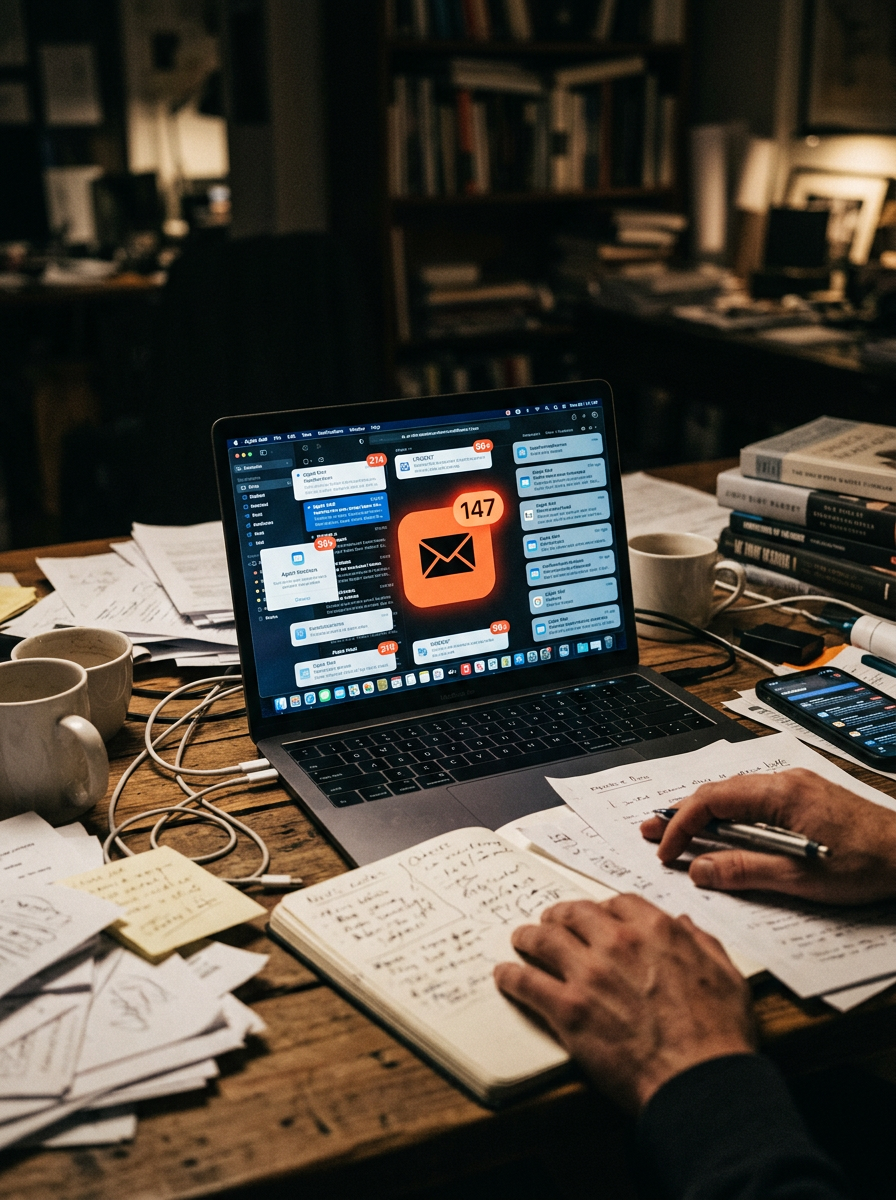
The digital workplace, for all its efficiencies, has introduced new forms of strain. Among the most pervasive is the constant demand for attention, often signalled by an incoming email. What began as a tool for asynchronous communication has evolved into a real-time interrupt, pulling focus away from concentrated work tasks.
This phenomenon is not simply about being momentarily diverted. Research indicates that frequent interruptions, even short ones, carry a significant cognitive cost, making it harder to return to a task with the same level of focus as before the interruption.
The Cost of Constant Alerts
A 2013 study published in the Journal of Experimental Psychology: Applied investigated the effects of email interruptions on task performance. Participants who were frequently interrupted by email took significantly longer to complete a task and reported higher levels of stress and frustration compared to those who received emails in batches or not at all. This suggests that the mere act of receiving an email notification, even if not immediately acted upon, can introduce a cognitive load.
Further research from the University of California, Irvine, highlighted that workers typically spend only around 11 minutes on any given project before being interrupted or switching tasks. After an interruption, it can take an average of 23 minutes and 15 seconds to return to the original task. Email notifications are a primary driver of these interruptions.
The brain does not seamlessly pick up where it left off after an interruption. There is a reorientation cost, a 'cost of attentional shift', that accumulates over the workday.
Why Notifications Disrupt More Than You Think
- Cognitive Load: Each notification presents a decision point: open or ignore. This seemingly minor choice consumes cognitive resources.
- Attention Residue: Even if an email is not opened, the mind may retain 'residue' from the potential content, making it harder to fully engage with the primary task.
- Perceived Urgency: Email alerts often trigger a sense of urgency, regardless of the message's actual importance, leading to increased stress.
- Reduced Flow State: Deep work, or a 'flow state', requires sustained, uninterrupted concentration. Notifications prevent the attainment or maintenance of this state, which is crucial for complex problem-solving and creative tasks.
The cumulative effect of these micro-interruptions is a fragmented workday, reduced capacity for deep work, and an increased likelihood of mental fatigue by the end of the day. It is not necessarily the content of the email, but the act of being interrupted, that exacts the toll.
Regaining Control of Your Attention
While eliminating email entirely is rarely feasible in most professional settings, managing notifications is a practical step towards mitigating their disruptive impact. Consider treating email like a scheduled task rather than a constant stream.
- 1Turn off all desktop and mobile email notifications. This includes audible alerts, pop-ups, and badge icons.
- 2Schedule specific times for checking email. For instance, allocate 20-30 minutes at the start of the day, midday, and before finishing.
- 3Communicate your availability. Inform colleagues that you check email at set intervals and for urgent matters, they should use an alternative communication method.
- 4Use 'Do Not Disturb' modes. Activate these features during periods requiring deep concentration.
These adjustments can help to create larger, uninterrupted blocks of time for focused work, reducing cognitive switching costs and potentially lowering overall work-related stress. The goal is to engage with email on your terms, rather than allowing it to dictate your attention.
Sources
- The effects of email interruptions on task performance and stress (opens in a new tab) — A 2013 study on email interruptions and task performance.
- The Cost of Interrupted Work: More Speed and Stress (opens in a new tab) — Research from the University of California, Irvine, on interruptions and recovery time. Note: PDF link, but from a university domain.
General information about work and health, not medical advice. See our medical disclaimer.