Consecutive Video Calls Teach You Not to Drink
When meetings run wall-to-wall, desk workers stop refilling their glasses to avoid missing a start time, mistaking the resulting afternoon headache for simple brain fatigue.
Work Survival Club · 4 November 2026 · 3 min · Original reporting
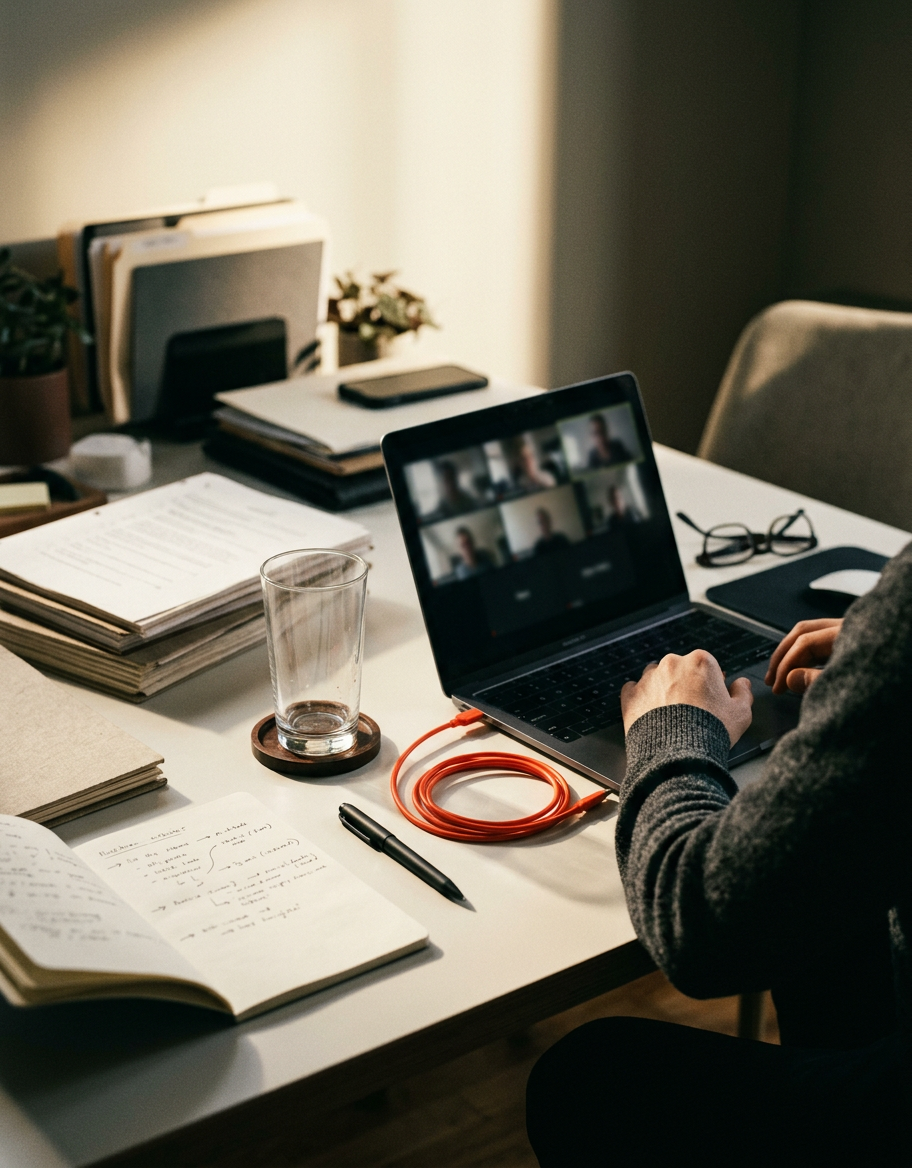
The glass of water on your desk sits half-finished from quarter past ten. You register the dry scrape at the back of your throat around half past one, but a glance at your monitor reveals three consecutive half-hour appointments beginning neatly on the hour. You leave the glass alone.
By four in the afternoon, a familiar dull band tightens behind your temples. You reach for paracetamol or another coffee, blaming the glare from a spreadsheet, poor chair posture, or the cognitive weight of the quarterly forecast. The root cause, however, is mechanical. You have spent six continuous hours actively rationing your fluid intake because your working environment penalises taking three minutes to walk to the kitchen.
The arithmetic of the zero-minute buffer
Standard calendar software defaults to thirty- or sixty-minute increments that snap together without a seam. On an administrator's screen, this arrangement looks like maximum efficiency. In a human body, it triggers an immediate conflict with basic homeostasis. Drinking the recommended two litres of fluid each day requires a person to empty their bladder every two to three hours. When an organisation treats consecutive bookings as normal, workers develop an informal compensatory habit that occupational health specialists describe as voluntary fluid restriction.
It is rarely written into policy, but it is an enforced bodily adaptation. When leaving a video call mid-sentence causes social friction, and arriving two minutes late to the next one prompts irritated glances from colleagues, the practical response is to stop putting liquid into your body. Knowledge workers learn to calculate the clearance rate of a cup of tea much like long-distance lorry drivers plan fuel stops on a motorway.
When leaving a call mid-sentence causes social friction, the practical response is simply to stop drinking.
How mild hypohydration drains the afternoon
Research on acute hypohydration—a loss of just 1 to 2 percent of body mass through fluid deficit—shows that the brain falters long before severe thirst appears. In controlled laboratory trials, this minor deficit reliably impairs working memory, heightens perceived task difficulty, and increases the frequency of tension headaches.
- Cognitive drag: Working memory and visual vigilance slow detectably once fluid loss reaches 1.3 percent of total body mass.
- Vascular tension: Intracranial fluid balance shifts under mild deficit, prompting cranial vasoconstriction that produces the characteristic 3 PM band across the brow.
- Inflated effort: Routine administrative tasks, document drafting, and collaborative discussions require higher subjective mental exertion when cellular hydration falls.
- The caffeine trap: Reaching for an espresso to counter the resulting lethargy introduces a mild diuretic effect without restoring the cellular fluid debt.
Statutory rights versus digital calendars
The Health and Safety Executive sets clear expectations under UK workplace welfare regulations: employers must provide readily accessible drinking water and adequate sanitary facilities. Yet calendar software operates in an accountability void. Colleagues can book every minute of your working day without accounting for the physical journey required to use those facilities. A schedule that prevents you from standing up is functionally identical to an obstruction in the hallway.
Rebuilding biological transit time
Treating afternoon lethargy with monitor risers, blue-light filters, or herbal stimulants fails because it mistakes a fluid deficit for an intellectual failing. Resolving the problem requires restructuring the workday schedule rather than demanding greater personal resilience from a dehydrated body.
- Shorten default durations: Adjust calendar settings to terminate 30-minute meetings at 25 minutes and hour-long meetings at 50 minutes, creating protected five-minute transit gaps.
- Normalise short absences: Post a brief note in the call chat indicating a two-minute water break rather than tolerating physical discomfort to maintain constant screen presence.
- Monitor the vessel: Keep a measured bottle at your desk and check its level at 2 PM; if the water line has not moved, the day's schedule has compromised your basic physiology.
A human body is an open hydraulic system, not a solid-state computer running indefinitely on grid electricity. When a workday schedule leaves no margin to drink or step away, the physical breakdown that follows is not a personal failing. It is a failure of basic schedule architecture.
Sources
- Mild Dehydration Affects Mood in Healthy Young Women (opens in a new tab) — Randomised controlled trial in The Journal of Nutrition demonstrating that fluid loss of 1.36 percent degrades mood, induces headaches, and impairs concentration.
- Water, Hydration, and Health (opens in a new tab) — Comprehensive Nutrition Reviews analysis of fluid regulation, the physiological effects of mild fluid restriction, and cognitive function.
- Dehydration Overview and Clinical Guidance (opens in a new tab) — NHS clinical overview of the systemic signs of fluid deficit, daily intake guidance, and headache prevention.
- Welfare at Work: Guidance for Employers on Welfare Provisions (opens in a new tab) — Statutory guidance from the Health and Safety Executive outlining legal duties to supply drinking water and accessible rest facilities.
General information about work and health, not medical advice. See our medical disclaimer.