Street Signs Blur on the Walk Home
When you step outside and the far wall or bus number looks smeared, your eyesight has not permanently failed. A tiny smooth muscle has spent eight hours clamped tight.
Work Survival Club · 18 November 2026 · 4 min · Original reporting
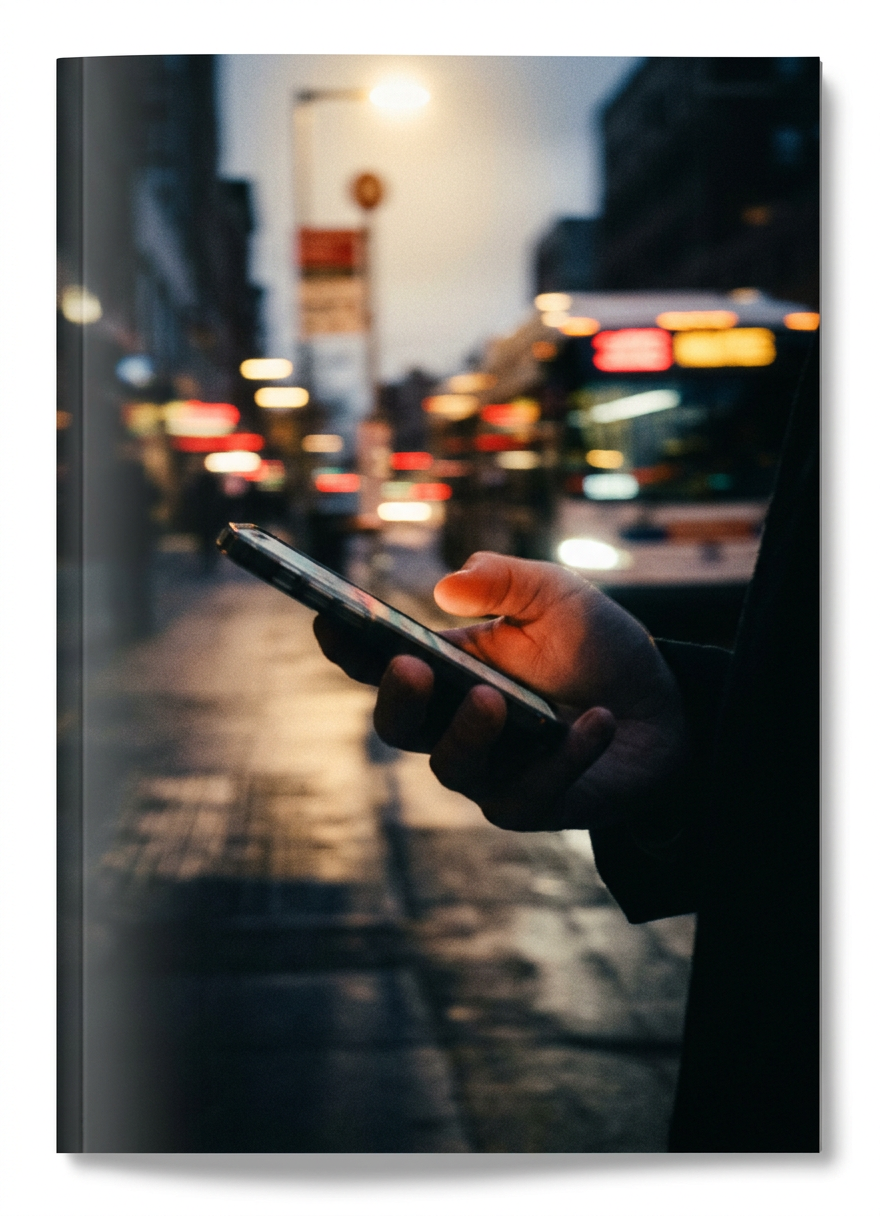
You pack your bag, tap out through the security barrier, and walk out into the early evening dusk. At the pedestrian crossing, you glance up at the street sign on the opposite corner, or look across the station concourse at the digital departures board for platform four. The white lettering carries a faint, irritating smudge. The edges of the characters are soft, bleeding slightly into the dark background, as though you are viewing them through someone else's glasses.
Most people assume their vision has slipped. You blink hard three times, rub the bridge of your nose, and make a mental calculation about how many years have passed since your last eye test. Yet fifteen minutes into the commute home, you glance at another sign and the crispness has quietly returned. Your prescription has not shifted over the course of a Tuesday. What failed on the station concourse was not your optic nerve or your cornea, but the mechanical release of an internal muscle that has spent the entire day locked in an isometric hold.
An isometric hold behind the iris
The human eye was engineered for a scanning mammal. Across an ordinary day in an open landscape, gaze shifts continuously between tracking hands, scanning thirty metres ahead for terrain, and flicking towards a horizon five kilometres away. To manage this, the eye relies on the ciliary body: a ring of smooth muscle encircling the crystalline lens. When you look at the horizon—anything beyond roughly six metres, which optometry categorises as optical infinity—this muscle is completely relaxed. The tiny suspensory ligaments (zonules) that connect it to the lens pull taut, flattening the lens into a thin disc suited for parallel light rays.
When you place a glowing rectangle exactly 50 centimetres from your face, that relaxed system terminates. To bend divergent light from a screen so it hits the retina cleanly, your ciliary muscle must contract. This contraction slackens the zonules, allowing the elastic lens to plump outward into a thicker, more curved shape. That physical squeezing action is accommodation. If you hold a one-kilogram bag of sugar at arm's length, your shoulder burns within four minutes. The ciliary muscle is smoother and far more resilient than skeletal muscle, but asking it to sustain continuous contraction for eight hours without a systemic release is asking for the ocular equivalent of a cramp.
The mechanics of the five o'clock blur
Ophthalmic researchers call this phenomenon nearwork-induced transient myopia (NITM), or accommodative hysteresis. When smooth muscle is stimulated continuously under parasympathetic tone, it does not instantly unclamp the moment the visual target shifts. The physiological relaxation time lengthens. Instead of shifting focus in roughly 350 milliseconds—the speed of a healthy, rested visual system—the ciliary body remains partially contracted, trapped in tonic accommodation. The crystalline lens stays too thick for distance vision, creating an artificial, temporary nearsightedness.
Holding a focal distance of fifty centimetres for eight hours is the visual equivalent of an unbroken isometric wall sit.
Studies reviewed by Sheppard and Wolffsohn in BMJ Open Ophthalmology note that accommodative fatigue is one of the twin pillars of digital eye strain, working alongside tear-film breakdown. Desk workers with high cognitive workloads frequently register a delay of several seconds before distance visual acuity returns to baseline. The harder you concentrate on dense text or spreadsheets, the less frequent your micro-shifts in accommodation become. By late afternoon, the muscle has simply lost its capacity to spring back instantly.
Why standard workarounds fail to release the lock
The popular remedy sold to office workers is the 20-20-20 rule: every 20 minutes, glance 20 feet away for 20 seconds. In modern open-plan offices or converted box rooms, this advice collapses on contact with reality. Glancing across the room at a grey partition wall three metres away does not achieve optical infinity; the ciliary muscle relaxes only fractionally. Similarly, tinted glasses that block blue wavelengths address contrast and dry air complaints, but they do nothing to alleviate the purely mechanical workload placed on the ciliary body.
- Optical infinity requires at least six metres: Looking at an opposite office wall four metres away still demands roughly 0.25 dioptres of accommodation. True muscular rest happens only when looking out of a window or down a long hallway.
- Screen distance dictates the load: Accommodative demand is measured as the reciprocal of distance in metres. A laptop perched at 40 centimetres demands 2.50 dioptres of continuous effort; pushing an external monitor back to 70 centimetres reduces that load to 1.43 dioptres—a 40 per cent reduction in muscular force.
- Scale the text, not the proximity: Workers consistently pull screens closer because the default system font is too small. Increasing system-wide display scaling to 125% allows the monitor to be positioned substantially further away without straining comprehension.
The Health and Safety Executive mandates that display screen users be provided regular changes of activity, specifically to mitigate visual fatigue. However, most workers treat a screen break as an opportunity to look at a smaller screen held twenty centimetres closer to their chest.
Resetting your depth before you leave the desk
You cannot eradicate nearwork if your job requires a monitor, but you can prevent the ciliary muscle from settling into an end-of-day spasm. Before closing your laptop, spend ninety seconds performing deliberate vergence and accommodation cycles. Pick an object at least twenty metres away—a chimney, a distant tree, or a rooftop visible through a window—and hold your gaze there until its edges sharpen completely. Then briefly focus on your thumbnail held at arm's length for two seconds, before returning to the horizon for ten. Cycling between the two forces the ciliary ring through its full range of motion, breaking the static hold before you step out to navigate traffic.
Sources
- Digital eye strain: prevalence, measurement and amelioration (opens in a new tab) — A comprehensive review by Sheppard and Wolffsohn (2018) examining the physiological mechanisms of accommodative fatigue and visual stress during screen use.
General information about work and health, not medical advice. See our medical disclaimer.