The Mid-Back Tightens Around Your Lungs
Eight hours of shallow desktop breathing freezes the joints between your ribs and spine, turning an afternoon yawn into a sharp pinch.
Work Survival Club · 18 November 2026 · 3 min · Original reporting
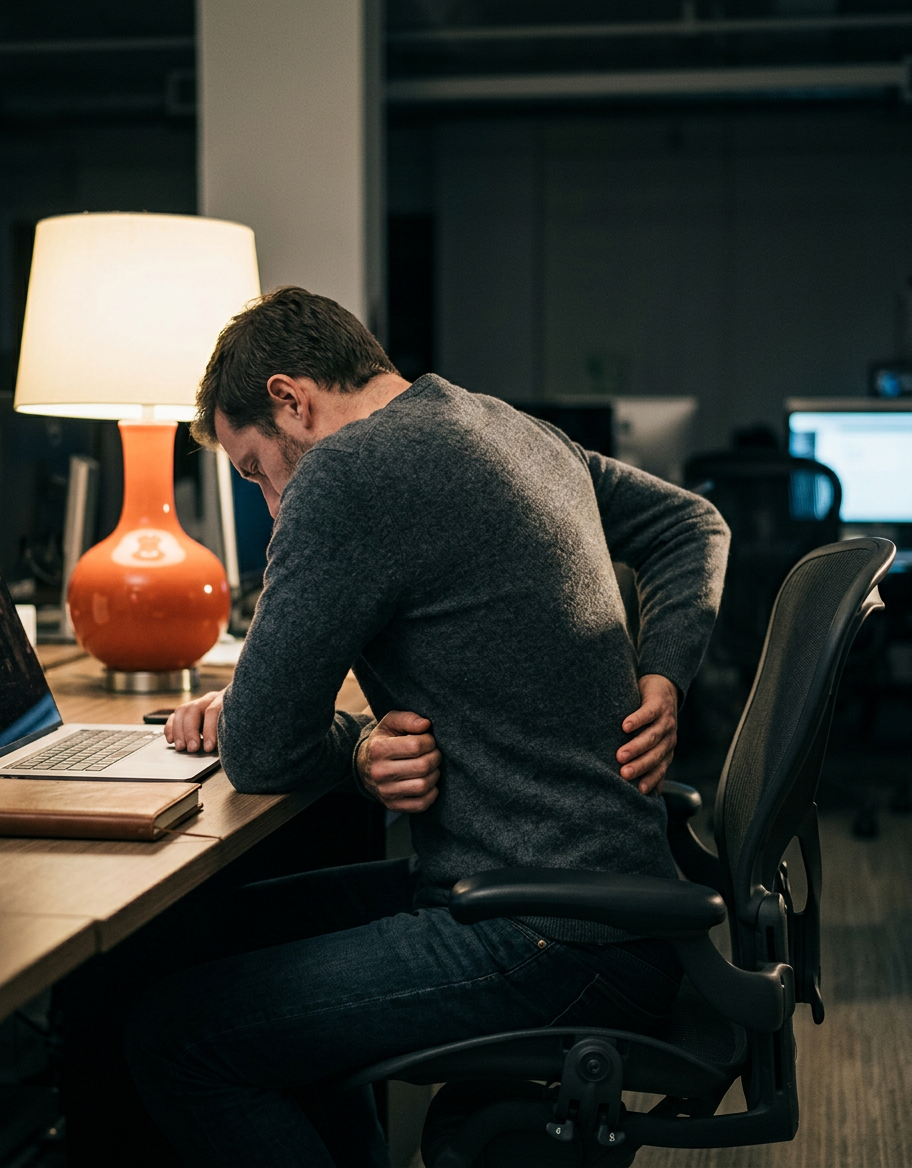
Around four in the afternoon, you lean back from your screen to stretch, open your mouth to yawn, and run into an unexpected wall. Halfway through the inhalation, your mid-back catches. The air stops short, not because your lungs are full, but because the back of your ribcage feels as though it has been laced into a stiff canvas corset. You blow the breath out, roll your shoulders, and try again, only to feel the same dull pinch between your shoulder blades.
The sensation is rarely muscle fatigue in the traditional sense, and it is not a lung problem. It is an articulate, mechanical protest from twenty-four tiny hinges that have spent eight hours doing almost nothing at all. While ergonomics articles obsess over lumbar curves and wrist angles, the thoracic cage quietly takes the brunt of desk-bound stillness.
Twenty-four hinges locked in park
Each of your twelve ribs meets the thoracic spine at two distinct points: the costovertebral joint, where the head of the rib rests against the vertebral body, and the costotransverse joint, where the rib neck connects to the transverse process. These are not fused bones; they are true synovial joints, complete with cartilage, joint capsules, and lubricating synovial fluid. When you inhale deeply, your ribs swing upward and outward like bucket handles, gliding smoothly across these spinal junctions.
That gliding motion depends entirely on demand. At rest, reading emails or editing a spreadsheet, your metabolic need for oxygen is low. You breathe shallowly, displacing roughly 500 millilitres of air per breath using minimal diaphragmatic movement. Your ribcage barely moves half a centimetre. For eight consecutive hours, those twenty-four synovial joints stay locked inside a tiny, repetitive fraction of their available range.
Synovial joints do not have an independent blood supply to deliver moisture; they require mechanical compression and release to circulate fluid through the cartilage.
What slouching does to chest volume
The mechanical penalty worsens when you lean towards your monitor. A slumped or forward-head posture drops the sternum, rounds the shoulders forward, and compresses the anterior chest wall. Research shows that slumped sitting reduces forced vital capacity and chest expansion compared to an upright or semi-reclined posture.
As the front of the chest compresses, the posterior ligaments and intercostal tissues along your spine are held under continuous passive tension. Synovial fluid within the costovertebral capsules thickens, a property of its thixotropic nature: when left undisturbed, joint fluid acts more like gel than liquid. By the time you attempt a deep yawn at 3:30 PM, the dried-out capsule resists the sudden excursion, triggering local nociceptors and a reflexive spasm in the surrounding rhomboids and erector spinae.
The predictable afternoon cascade
The physical consequence of thoracic hypomobility is not confined to an awkward yawn. When the ribcage stops expanding posteriorly, your body compensates through whatever moveable parts remain:
- Accessory neck breathing: Because the lower ribs are restricted against the backrest or compressed by a forward slump, the scalenes and sternocleidomastoid muscles in the neck work overtime to hoist the top two ribs upward.
- Cervical and shoulder strain: As upper respiratory muscles fatigue from lifting the chest, tension radiates directly into the base of the skull, contributing to late-day tension headaches.
- Intercostal splinting: Surrounding muscles contract defensively to protect the stiffened joints, creating the familiar, frustrating sensation that someone is pressing a knuckle into your mid-spine.
Pumping the joints without leaving your chair
Correcting mid-back tightness does not require buying an expensive back-stretching wheel or performing theatrical lunges between video calls. It requires restoring full articular excursion to the costovertebral joints before the synovial fluid thickens into an afternoon paste.
Twice a day, take three slow, deliberate breaths aimed not at your belly, but directly into the space between your shoulder blades. Cross your arms over your chest, drop your chin slightly, and inhale until you feel the ribs physically push outward against your back. Follow this with thirty seconds of gentle thoracic rotation: plant your feet flat, keep your hips still, and rotate your shoulders left and right, letting your arms swing loosely across your torso. The costovertebral joints do not need hours of rehabilitation; they just need proof that you still intend to use them.
Sources
- Effects of Forward Head Posture on Thoracic Shape and Respiratory Function (opens in a new tab) — Peer-reviewed study in Journal of Physical Therapy Science detailing how typical forward-leaning computer postures restrict thoracic mobility.
- Working with Display Screen Equipment (DSE) (opens in a new tab) — UK Health and Safety Executive guidance on posture, regular breaks, and the prevention of musculoskeletal disorders from prolonged desktop work.
General information about work and health, not medical advice. See our medical disclaimer.