Footrests Exist Because Desks Do Not Move
Under-desk foot supports are rarely an upgrade in their own right; they are a necessary patch for standard work surfaces built too high for half the workforce.
Work Survival Club · 14 November 2026 · 5 min · Original reporting
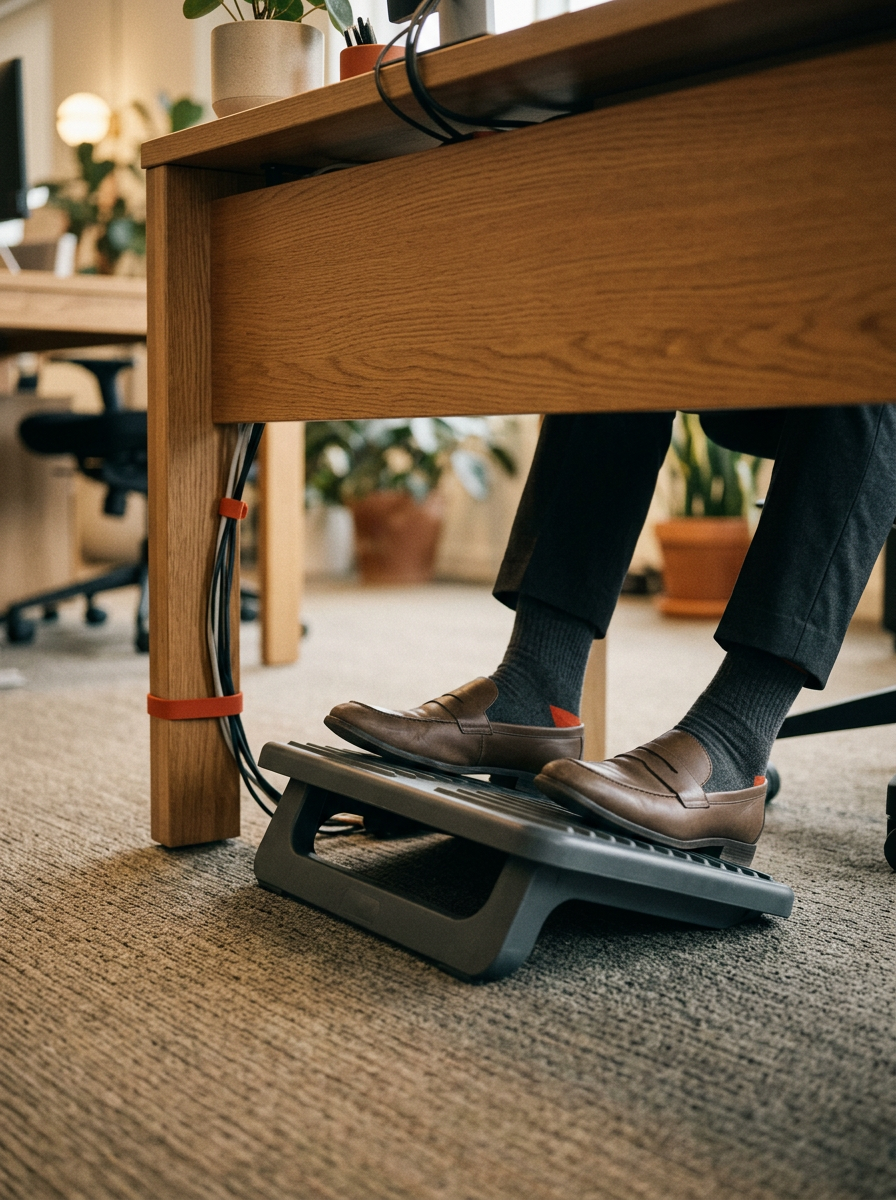
Most commercial office furniture in the United Kingdom and Europe is built to a single, stubbornly fixed height: approximately 72 to 74 centimetres. That dimension was standardised in the mid-twentieth century around the sitting height of a man standing roughly five foot ten inches tall. If you are shorter than that, or if you have a shorter torso and longer legs, the geometry of a standard desk fails immediately. To position your forearms parallel to the work surface without hiking your shoulders toward your ears, you must jack your office chair upwards. The moment you do, your heels lift away from the carpet.
What follows is predictable circulatory compression. Without a floor to bear the weight of your lower limbs, gravity pulls the underside of your thighs hard into the front edge of your seat pan. In occupational ergonomics, this is known as popliteal pressure. It restricts venous return from the calves, encourages lower leg fluid retention, and causes workers to perch on the front third of their chairs, abandoning their lumbar support entirely. An under-desk footrest is not a luxury accessory. It is an artificial floor designed to fix an inflexible desk.
The mechanical problem of the dangling heel
Regulators treat this problem with surprising seriousness. The Health and Safety Executive specifically mandates that employers provide a footrest if an employee’s feet cannot rest flat and comfortably on the floor once their chair has been adjusted to keyboard height. The Canadian Centre for Occupational Health and Safety similarly stresses that a footrest is an indispensable substitute floor, preventing compression of the femoral and popliteal blood vessels.
When your feet hang unsupported, the weight of your lower legs (roughly ten percent of your total body mass) is transferred entirely into the soft tissue behind the knees. Classic laboratory work on occupational leg swelling, including studies indexed on PubMed, demonstrates that immobilising the legs while seating workers with high seat-to-floor heights significantly increases lower limb fluid accumulation over an eight-hour shift. Your nervous system compensates for this discomfort by prompting you to slouch forward, slide your hips toward the knees, or tuck your feet under the chair wheels—all of which destabilise the pelvis.
An under-desk footrest is not an ergonomic upgrade. It is an artificial floor designed to patch a piece of furniture built for someone else.
What the market sells versus what actually works
(A brief declaration of how we work: Work Survival Club uses affiliate links for hardware we recommend. If you purchase through our links, we may earn a modest commission. We buy or borrow hardware anonymously where possible and do not accept sponsored placements.) The consumer footrest market is flooded with cheap foam wedges and brittle plastic platforms designed more for impulse purchasing than daily mechanical duty. Having tested the major form factors across weeks of eight-hour typing shifts, the divide between functional tools and waste is stark.
- High-density memory foam pillows (Avoid): Marketed heavily on internet retail sites as soft and cloud-like, foam teardrops collapse within twenty minutes under the continuous downward force of two human heels. Once compressed, they provide almost zero elevation, trap heat, gather dust from socks, and skid across hardwood floors.
- Lightweight plastic rockers with textured bumps (Avoid): These cost between £15 and £25 and appear in hundreds of corporate supply catalogues. The massage nodules dig uncomfortably into bare feet or thin socks, while the hollow plastic chassis flexes, squeaks, and flips over whenever you shift your weight.
- Heavy steel or solid timber adjustable platforms (Worth the money): To function as a real floor, a footrest requires substantial mass so it does not slide backward under leg pressure. It must offer independent height steps (at least five to fifteen centimetres) and a lockable tilt mechanism, providing a broad, friction-coated surface that accommodates wide, relaxed foot placement.
- Active rocking footboards (Conditionally worth it): Curved wooden rockers allow periodic ankle flexion, engaging the calf muscle pump without forcing you out of your chair. They work well for workers prone to calf stiffness, provided the board has rubberised runners that do not scratch flooring.
The three checks before you spend anything
Before ordering a platform, verify whether you actually need one, or whether your current chair setup simply requires recalibration. Guidelines from the Occupational Safety and Health Administration outline the correct sequence for diagnosing your workstation geometry.
- 1Adjust for the desk first: Sit all the way back in your chair, let your shoulders drop completely, and bend your elbows to ninety degrees. Raise or lower your chair until your forearms align flat with your keyboard and mouse. Do not drop your seat just to hit the floor; your shoulders will pay for it by noon.
- 2Inspect the gap behind your knees: With your forearms in position, slide two fingers between the edge of your seat cushion and the back of your calves. If your thighs press firmly into the front edge and your heels cannot press down flat, your seat is higher than your lower leg length. You require a raised surface.
- 3Measure the deficit with books: Stack two or three thick reference books or a firm yoga block beneath your feet. If your pelvis immediately rolls back against the lumbar cushion and thigh pressure dissipates, note the height of the stack. That measurement is the minimum platform elevation you need to purchase.
Our pragmatic recommendation
If you work at a rented flat or a corporate hot desk where changing the desk height is impossible, skip the £18 foam cushions. Look for an all-metal, non-slip unit like the Fellowes Climate or Kensington SoleMate Pro, or a solid plywood rocker from an independent timber workshop. Aim for a platform at least 45 centimetres wide so you can vary your stance throughout the day. If your desk height is already adjustable, however, save your money entirely: drop the desktop down to 65 centimetres and let your heels do their natural work on the floor.
Sources
- Occupational Safety and Health Administration: Computer Workstations - Footrests (opens in a new tab) — US federal workstation checklist identifying when non-adjustable desk surfaces require supplementary foot elevation.
General information about work and health, not medical advice. See our medical disclaimer.