Walking Pads Slow Your Hands Down
Under-desk treadmills promise painless mileage, but fine motor control and dual-task interference charge an unforgiving toll on actual work.
Work Survival Club · 14 November 2026 · 3 min · Original reporting
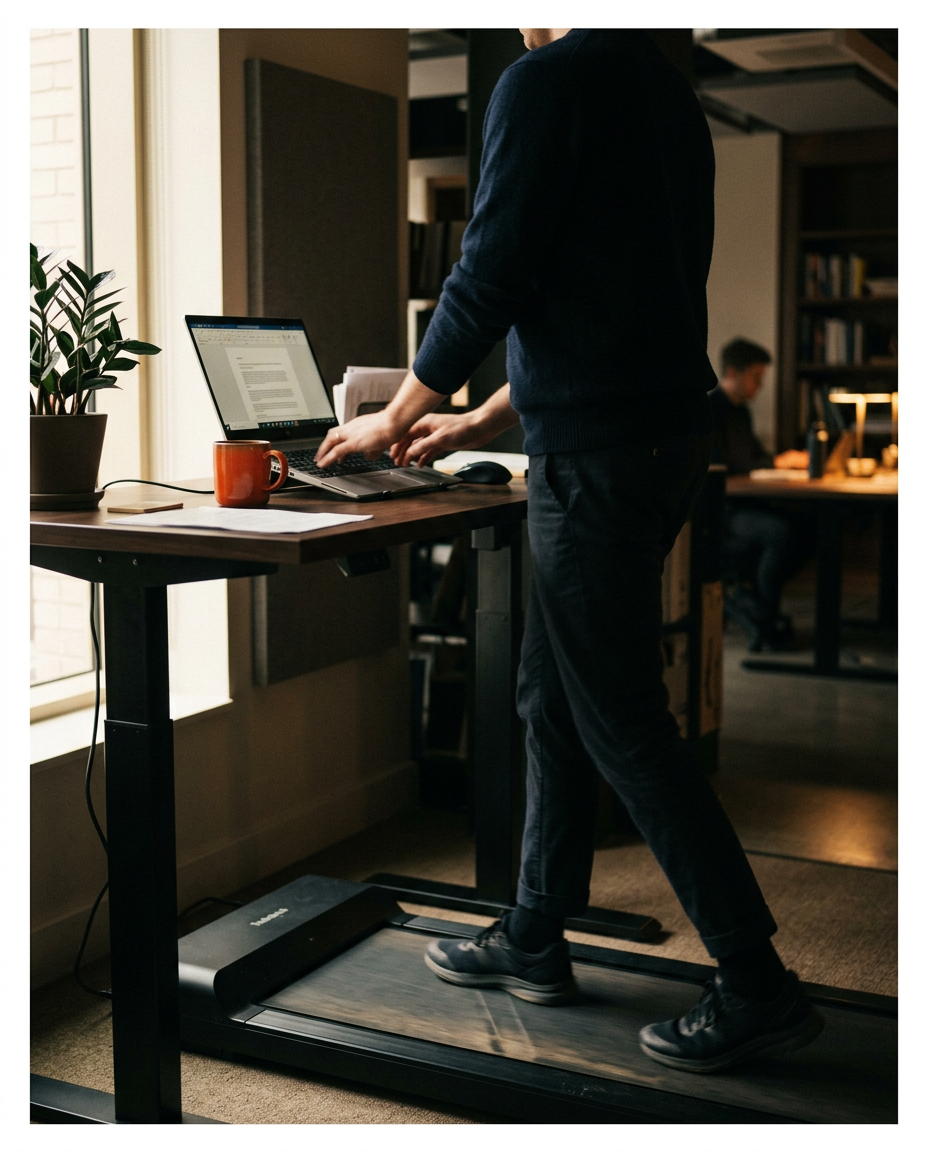
The courier leaves a flat, twenty-five-kilogram carton on your doorstep, and for about forty-eight hours, modern working life looks solvable. The device inside is an under-desk walking pad: an electric ribbon of vulcanised rubber encased in aluminium, slim enough to slide under a sofa and pitched as the antidote to eight consecutive hours in an office chair. The promise is frictionless virtue. You will clear your morning inbox, draft a spreadsheet, and log twelve thousand steps before eating lunch, all without leaving your desk.
Three months later, an overwhelming proportion of these machines sit on their ends behind a spare bedroom door, gathering grey felt-dust in the narrow gap between a wardrobe and the skirting board. The failure is rarely mechanical. Most walking pads work exactly as manufactured. What breaks down instead is the biological fiction that humans can perform fine motor precision and intense cognitive synthesis while keeping their bodies on a continuous moving track.
The motor tax on fine movements
When you walk across a solid floor, your brain relies on automated spinal neural circuits known as central pattern generators. You do not consciously instruct each hamstring and soleus muscle to contract. But when you place your feet on a motorised treadmill belt, the equation shifts. Walking on a constrained, moving surface requires continuous visual and vestibular recalibration to avoid drifting off the side or clipping the front cowling. Your motor cortex devotes real cognitive resources simply to keeping you upright and centered.
Try pairing that background balancing effort with the precision of a computer mouse. Ergonomic research published in Preventive Medicine and Applied Ergonomics shows that typing speed falls by between six and eleven percent when walking at standard desk speeds (roughly one to two kilometres per hour). More damningly, mouse error rates spike by over twenty percent. Dragging a spreadsheet cell, highlighting three words of text, or hitting a narrow dropdown menu suddenly requires multiple micro-corrections because your entire shoulder girdle shifts slightly with every heel strike.
The friction of twenty-five kilograms
Beyond neurobiology, walking pads suffer from acute logistical drag. An under-desk treadmill cannot share floor space with your office chair. To use it, you must unplug your chair, wheel it across the room into an inconvenient corner, haul a dense machine out from beneath the desk, align it with your standing desk surface, plug it into the mains, and put on running trainers. Walking in soft socks or bare feet on an abrasive running belt causes blister-friction and arch strain within half an hour.
A tool that requires furniture removal before every routine meeting will inevitably spend its life propped behind a wardrobe.
Then comes the noise. Even models advertised with brushless motors at under forty-five decibels emit a repetitive, rhythmic thud as shoes contact the deck. Sensitive condenser microphones pick up that low-frequency drone instantly, turning your voice on conference calls into an acoustic imitation of a low-budget freight train. You end up pausing the belt every time a meeting starts, stranding yourself standing awkwardly on a narrow metal deck.
When it works, and when it fails
The device is not entirely useless, but its utility depends strictly on task taxonomy. It is an exceptional tool for low-stakes, receptive work, and a disastrous one for generative, precision work.
- Hopeless on the belt: Drafting detailed prose, coding, navigating financial spreadsheets, doing graphic design, and typing during live text chats where speed matters.
- Viable on the belt: Listening to all-hands meetings where your camera and microphone remain off, watching mandatory compliance training videos, and reviewing recorded presentations.
- The sweet spot: Voice-only phone calls where you take notes on paper after the conversation, or reading long PDF documents where the only physical input required is the down-arrow key.
The buying calculus
If you are determined to buy one, ignore marketing claims about sprint speeds and folding hinges. Look for three specifications: a flat walking deck with no raised motor hood that trips your toes, a minimum belt length of 115 centimetres so your natural stride is not clipped, and wheels robust enough to roll across carpet. Set an automated price alert; walking pads depreciate rapidly, and the second-hand market on local classified sites is perpetually flooded with mint-condition models sold by disappointed knowledge workers.
Yet before spending three hundred pounds, test the premise honestly. A twenty-minute walk outside in natural light, conducted completely away from Slack, provides cardiovascular benefits and mental recovery that two hours of robotic shuffling across an Excel workbook can never match. If you want to move, step away from the keyboard entirely.
Sources
- Treadmill Workstations: The Effects on Physical Activity and Performance (opens in a new tab) — Longitudinal field trial published in PLOS ONE examining real-world office worker performance and physical adaptation to walking workstations.
- Working with display screen equipment (DSE) (opens in a new tab) — Statutory guidance from the UK Health and Safety Executive outlining postural stability, musculoskeletal safety, and workstation design principles.
General information about work and health, not medical advice. See our medical disclaimer.